Showing posts with label Risk management. Show all posts

Jan 8, 2019

Post #54: Short Play $CHP

chart by marketwatch.com
Latest: January 14, 2019
Price: Php 1.98
Conclusion: Cut loss hit (SOLD)

Latest: January 13, 2019 (10:40 PM)
Price: Php 2.03
Stop: Php 2.00

Update: January 8, 2019 (11:00PM)
Price: Php 2.14 (+7%)
Stop: Php 2.00

Disclaimer: This is only a stock simulation trade. Follow at your own risk. Proper risk management measures should be observed in every trade.

Post #53: Trading simulation ($AEV)

chart by www.marketwatch.com
Update: January 21, 2019
Price: P66.60
Stop: P64
Approx +15%


Latest: January 15, 2019
Price: Php 64.80
Stop: Php 60

Latest: January 13, 2019
Price: Php 60.00
Stop: Php 58.00

Update: January 8, 2019, 10:00 PM
Price: Php 57.20 (no change)
Stop: Php 55


Disclaimer: This is only a stock simulation trade. Follow at your own risk. Proper risk management measures should be observed in every trade.

Jan 3, 2019

Post #52: My 2018 results

I had a very disappointing 2018, my entire portfolio suffered a -19% loss. My stock picking only had 33% success rate, picking only 9 winners out of the 27 trades I took last year. Though I managed to keep my risk percentage within my limit, my poor stock picking numbers really hurt my portfolio's entire performance. 


I forced some of my trades in a downhill market; and the market taught me a hard lesson. My strategy will not work on a down-trending market, I actually knew that, but still I tried to enter positions I thought are feasible. I knew I should listen to the market, but I still took some risk and I paid for it with my money. A different kind of market needs a different kind of approach, that's my main takeaway from this lesson. I cannot be a momentum trader in a market for swing traders. 

This year, 2019, the PSE index started the year ranging between 7400 and 7600; a breakout of the range might show the direction of the market. I like the fact that we seem to be independent of what's going on with the world markets right now. Our market seems to be shaping it's own direction. It is exciting to see where this is heading.

Losing gives us opportunities to learn and evaluate our selves. I will consider my 2018 draw-down as just another lesson learned. Trading for me is a long game, and a year of negative return will not deter me but will instead fire me up to learn more. We all still have our best years ahead of us. Keep grinding , keep learning. 


Nov 27, 2018

Post #51: PSEi update

PSEI 5 year weekly chart by www.Bigcharts.Marketwatch.com

The Philippine stock exchange index (PSEi) seems to be displaying a corrective wave in its downtrend. I will still remain cautious and will not enter in any position. Although some bounce plays are possible in this scenario, it is something that I don't intend to take anymore. I am in the opinion that the downtrend is still intact and the possibility of downward continuation is highly possible.

I'm still sticking to my plan of not trading a generally bearish market. I am willing to wait for the market to tell me when it's time to go back again. There is no rush to make money in my part; I consider trading as a long game and I'm planning to stick around as long as I can. I believe the key to longevity and winning in this game is risk management.

I will be just watching the market until my signal tells me it's time to take some position. I might even end the year without entering any position. I'm sticking to my guns.


Jul 18, 2018

Post #49: My trading system flowchart

Lately, I am making an effort to make my trading as systematic as possible.  My goal is to set definite trading rules that will eliminate any second-guessing and emotions in my executions. Below is an overview of what I am currently doing.  I decided to show it in a flowchart form.


The very first step is to asses the general market's trend. This is where I will decide whether the market situation is favorable or not. It is also where I decide if how much of my capital will be put into position and how much will stay liquid. For example, in a down-trending market I might want to be only 25% in position and stay 75% in liquid cash.

Stock selection is where I decide what criteria will be factored in before a stock enter my watch-list. I am using both technical and fundamental factors. For example, I like stocks that are showing tight volatility ranges with increasing volumes. Fundamental factors includes P/E ratios, float % and many others.

Specific entry criteria is where I intend to enter a position. One example is a good upside breakout of a tight ranging stock with above average volume. I am looking for various set ups and I'm using a specific entry point strategy to avoid confusion in my execution.

Risk management is where I set up entry stops, position sizing, trailing stops and my risk tolerance. This is where I also scale my position up to avoid getting hurt in whipsaws. I believe this is one of the most important process that traders should focus.

Selling is where I set specific rules on when to sell my positions. Example of this is when the price hit my trailing stop or when the price is showing some topping signs.

Last, but also the most important part of my system, is the feedback and trading review part.This is where I review my trades to see if there's any part of the system that needs to be revised for improvement. No system is perfect, that's why constant feedback is important.

That's how simple my system will be. Although revision is expected, I will try to always keep it as simple as i intended it to be. There is no need for an over-complicated system, but at the same time you also need specific rules and system if you want to be successful in this endeavor. Otherwise, your trading will be driven by your emotions and it will become just some random buy and sell transactions without any clear justification.

Jan 30, 2018

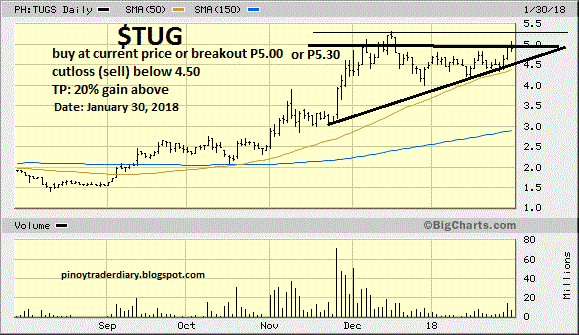
Post 46: Sample trading plan $TUGS (last update Feb. 23,2018)

Today, I am posting one of my trading plan. I was so focused on my trading and other stuff that I wasn't able to post something new here. So here it is, at least just to keep the blog updated.

This sample trade will also show how simple I do my trading.

I made a simple sketch below on how I'm gonna trade $TUGS.


This plan only includes my entry and cut loss price. For more details on how I sized my position and manage my risk, please read here. 

Please take note that I put a 20% TP only for reference (not actual), as I usually like to trail my stop so my selling price is not fixed. Read here why I don't like using TP (Target prices).

Want to know how I did last year? Read it here. 

I will try to keep this post updated as often as I can.

Notes: IMO, Immediate index support is at PSEi 8800, and anything below PSEi 8500 will cause me to lighten up my positions significantly.


Cheers.

Update: February 2, 2018


After seeing some strenght with the stock yesterday, I added $TUGS to my portfolio with an average price of P5.02/share. The breakout from an ascending triangle set up coupled with some significant increase in volume triggered my BUY signal. The stock reached it's 52-week high of P5.70 today but closed at P5.37 (+2.48%) mainly due to profit taking. I am currently putting my stop at P5.00. Next week, we'll see if the breakout is confirmed and the stock will start a new trend or if it is just one of those false breakout case.

Re: Index (PSEi). I'm glad the index went back above 8800 again. My stop will still be at PSEi 8500.

Update: February 13, 2018


So $TUGS broke its P5.30 resistance and is now at around P5.80. I moved my stop at P5.30 breakout point. I'm a a little uneasy that $TUGS volume is not increasing at this breakout, so I'll be watching this stock in the next few days to see if it will show life. I'm currently at approx +15% gain but I am willing to let the stock do its thing for now. Let's see..

Update: February 19, 2018 


chart by www.bigcharts.marketwatch.com
$TUGS showed some good price action today, reaching its 52-week high of P6.09. The lack of bigger volume is concerning though as it looks like it has no interest from fresh buyer to push the price higher. A breakout of P6.00, with volume spike, is an oppurtunity to add more position or even as an entry point for new buyers. I'll put my stop just below P5.50 as it will mean that the stock broke down of its trading range and might not be ready for a breakout yet. Profit at approx 16%.

Update: February 23, 2018

After almost 3 weeks of holding $TUGS I sold it with a meager profit of approx 8% when it hit my stop at below P5.50. The index is not really doing well below 8500, so I am expecting most of the stocks to correct as well. I believe trades should end either with a big profit, a small profit or a small loss; that's why I am putting a lot of emphasis on my trailing stops. Avoiding big losses is the key to longevity in the market.

$TUGS will remain on my watch list for now.


Cheers.

Jan 2, 2018

Post 45: Lessons from my top 5 trades last year (2017)

They say that we can learn a lot of lessons reviewing our loses and mistakes, while it is accurate, I also believe that we can learn a lot from reviewing our winning trades.

Below are my top 5 winning trades last year. While I am happy with my profits, my numbers showed I only have approx 21% average profit last year. (See previous post) Quite low if you ask me.

Reviewing my trades helped me identify problems in my process. Because of it I can implement some improvements that will hopefully improve my results this year.

1. $ROCK

chart by www.bigcharts.marketwatch.com
I noticed an increased in volume and a slight uptrend mid-November that triggered my buy signal. Sold it when it broke the trendline Dec. 15, 2017. I timely avoided a turn of trend in this trade.


2. $MAC

chart by www.bigcharts.marketwatch.com

Bought it September when I saw a tightening price volatility with an increase in volume. Sold it Around November 22 with a 41% profit when it broke my trailing stop.

This stock perfectly stayed above 50 SMA, which is usually my last line of support in a trade. I could've hold it and be alright by now. It looks ready to take another breakout this year, I'll be closely watching.

Also, I could've seen this stock earlier if I am diligently doing my research. I could've bought it around June or July of 2017. This reminds me to do my research and screening diligently so that I wont miss many buying opportunities in the future.

3. $WLCON

chart by www.bigcharts.marketwatch.com
Bought this twice in May with an average of P5.42/share. Held on to it until I am convinced that it broke the 50sma on October 11, 2017.

Starting now, I will respect the 50sma as my last line of support. I guess I was hoping for the price to go up once more and give me the opportunity to sell at a higher price. Hope is not a strategy. Follow the plan.

4. MRP

chart by www.bigcharts.marketwatch.com

Here is another one that I bought a little late. January 2017 is where the ideal entry should be. I guess I'm not religiously doing my screening by that time again. (reoccurring mistake).

Another mistake I made is when I sold this at P8.68, a safe distance from any of my trail stops. I could not explain this one, I don't know why I sold this at this price. I could've squeezed a little bit more from this trade if only I have just defined my selling strategy.

It is very evident by now that I need to work on my selling strategy. Something I am planning to improve this year.

5. $IMI


By now I have to admit that I have a very faulty selling strategy. This one is a good run from my entry price of P6.91 to my selling price of P13.30 in August.

Why do I feel like I sold too late this time? I know I did.

The stock broke 50SMA and I sold it. I followed my plan but I still lost a big chunk of the profit and I felt bad about it.

Conclusion

It is very clear by now that I should be working on my selling strategy. I don't have the perfect system yet and this trades proved it. I am currently working on a selling strategy to at least improve my profit's average percentage.

I will also be allocating more time in screening potential winners for me to catch them in their earlier stages. Nothing beats a lower average price.

My batting average of 52% (13 out of 25 trades) is good enough, but I need to catch these winner earlier and learn how to sell them. A concrete plan with a win-win result is on the drawing board.

By reviewing my trades,  I know where my mistakes are. Knowing my mistakes will help me create a specific plan to address each of them.

My next post will be about my top 5 losers.

Oct 31, 2017

Post #39: Risk tolerance and position sizing

A lot of people have been asking me about position sizing and how do I manage my risk, so I think it is about time for me to explain it here.

To put it simply, it all starts with my risk tolerance. 

What is risk tolerance? For me, it is the percentage of my capital that I am willing to risk in every trade. 

I'm gonna give you an example to make it clear.

Let's say for example that  you have P100,000 starting capital. How much of it are you willing to lose in every trade you make? Is it P2000, P5000, or more? The amount is entirely up to you.

Let's say you are willing to lose only P2000 per trade. So your risk tolerance is 2% of your trading capital.

Capital = P100,000
Risk tolerance = 2%
Risk/trade = P2000

Let's do a trade example to make it more clear:

Supposed that you want to buy $STI at P1.80.
You also want to put your stop at P1.60.

chart from www.bigcharts.marketwatch.com


All you have to do is calculate how many shares you have to buy for you to be stopped at your 2% risk tolerance in case your trade goes wrong.

Let's do the math.

Total capital x Risk tolerance % =  Risk per trade
(P100,000 x 2%)  = P2000

Buy price - Stop loss price = Risk per share
(1.80 - 1.60 = .20 cents)

Risk per trade divide by(/) Risk per share = Position size
(P2000/.20 cents = 10,000)

It means you can buy 10,000 shares of $STI at P1.80 price with a stop loss at P1.60.

10,000 shares of $STI at P1.80 will be worth P18,000.

If it breaks its support at P1.60 and you sell it, it will total in cost at approximately P16,000.

(P18,000-P16,000 = P2,000)

You lost P2000, which is still within your 2% risk tolerance.

It is that simple.

Notes:

This is just an example, you can choose your own % in risk tolerance. You can even include broker commission charges if you want to be precise in your calculation.

It is advisable not to go beyond 2% risk tolerance to preserve your capital. This way, you can minimize losses even if you are always stopped out in your trades. As long as you keep winners run and stick to your cut loss discipline, you will end up on the profit side most of the time.  Besides, if you're always stopped out it means you need to work on your entry strategy.

You can add more position if the price of the stock goes up.

Always trail your stop. How to determine it is entirely up to you. You can use support and resistance, moving averages, Fibo retracement or whatever it is that works for you.

Hit me up for question.


Alex